CompetitionBrief
Simulation-trained humanoid footballers win two tournaments: 76 goals scored, 11 conceded
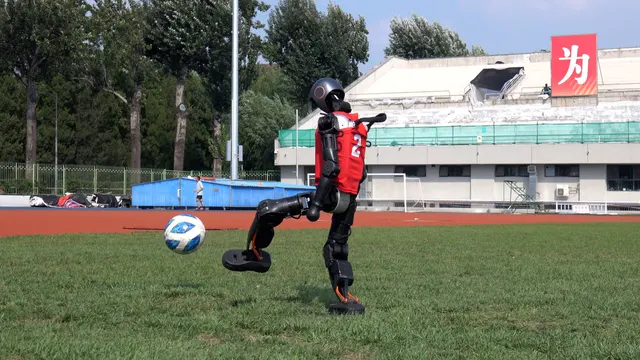
Researchers at Tsinghua University describe in Science Robotics how they taught a humanoid robot to play football, TechXplore reports.
In 2025, the Tsinghua Hephaestus team used the researchers' control system at two international competitions: the RoboCup Adult-Size Humanoid League, then the World Humanoid RobotA robot whose form follows that of the human body, with a torso, two arms, a head and most often two legs.Read the glossary entry Games. It won both. In total, its robots scored 76 goals and conceded only 11.
In tests on a real robot, the ball ended up in the back of the net in about 80 to 90% of shots taken from the attacking half of the pitch.
Rather than fixing the robot piece by piece through trial and error, the team trained its control system in a computer simulation.
The simulation deliberately introduced vision errors, delays and moments when the ball was not detected. The robot thus learned to guess where the ball probably was, so it could keep playing when it lost sight of it.
The researchers acknowledge a limitation: for now, the robot only takes account of the ball and the goal, and does not consider the other players on the pitch.
Source
- TechXplore (Robotics) · techxplore.com
Also worth reading
What next