Lunar explorationBrief
Robot Newspaper says JPL is aiming for late 2028 to send a nuclear-powered rover to the Moon’s south pole
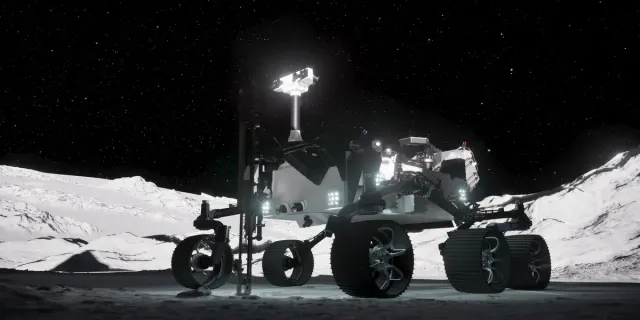
To drive on the Moon, the US space agency is mostly reusing parts designed for its Mars robots Curiosity and Perseverance. The information comes from a Jet Propulsion Laboratory video, relayed by IEEE Spectrum.
This video has no subtitles.
According to a video from NASA’s Jet Propulsion Laboratory, the PROMISE rover will be powered by nuclear energy. It is due to travel to the Moon’s south pole (pôle Sud in French).
The mission is presented as a founding step of NASA’s Moon Base programme. The name PROMISE stands for “polar rover for observation, mapping and on-site exploration”.
The rover will be built largely from existing hardware: test-bed components and flight spares developed for the Mars missions Curiosity and Perseverance, which are still under way.
Update, 16 November: according to Robot Newspaper, NASA’s JPL is aiming to launch PROMISE in late 2028. The rover is to search for water and ice to prepare for a future lunar base. The newspaper says the initial mission is to last 18 months and that the rover is to be delivered to the lunar south pole by Blue Origin’s Mark 1 lander. According to the newspaper, PROMISE is to carry a drill able to dig up to 1 m below the lunar surface. It is also meant to be able to drive in the dark with limited human intervention.
Sources
- IEEE Spectrum (Robotics) · spectrum.ieee.org
- 로봇신문 Robot Newspaper · irobotnews.com
Also worth reading

What next