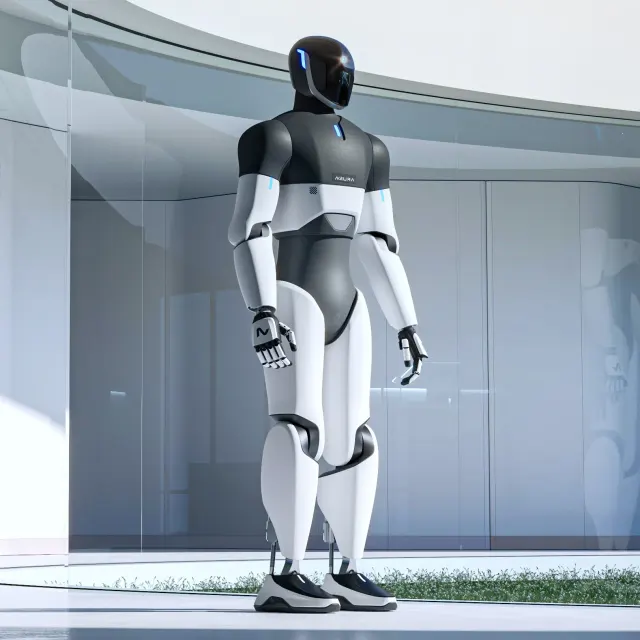
Price announcedGuides
NEURA 4NE1 can be reserved for €100, with the humanoid priced at an estimated €98,000 before tax
NEURA Robotics’ 4NE1 humanoid can be reserved for a refundable €100, with an estimated price of €98,000 before tax and shipping and availability expected at the end of 2026. But generation 4 has already been shown, its weight runs from 64 to 80 kg depending on the page and the home remains a promise, according to the pages read on 16 November 2026.
What you can reserve today: the Gen 3.5
NEURA Robotics’ reservation page is for the 4NE1 Gen 3.5. The deposit is €100 per unit. According to the page it is fully refundable, credited toward the final price and can be reclaimed at any time before the final purchase agreement is signed; it secures a place in the delivery queue. NEURA writes that the Gen 3.5 is expected to be available at the end of 2026 and warns that the hardware and aesthetics may be refined before then.
The listed price is an estimate: €98,000 per unit, excluding taxes and shipping, with volume discounts possible. On 22 October Vuntum had noted a €60,000 tier from twenty units on the German page; it is gone from the English and German pages read on 16 November, both modified on 12 November. Each unit is delivered complete, with integrated high-dexterity hands, a high-capacity battery and a charging station; specialised or third-party end effectors are not included.
The page says these reservations are intended for individual orders and sends industrial or commercial quantities to a contact form. It does not say whether a private individual can buy, and it gives no figure for weight, payloadThe maximum mass a robot arm can carry at its wrist.Read the glossary entry or battery life. A price of this order puts the robot on the side of professional buyers rather than the household: that is Vuntum’s reading, NEURA does not put it that way on this page.
Generation 4 is announced, but it is not the one you reserve
On 22 October 2026, at the opening of the TUM RoboGym in Munich, NEURA presented the fourth generation of the 4NE1 (Gen 4 sheet): a slimmer body covered in a textile skin, 20% lighter than the previous generation, more precise hands and limbs with built-in reflexes, each able to react on its own. The maker writes that it already works in its NEURA Gyms (centres where robots train on real tasks) and is being prepared for series production, with no date and no price.
On the 4NE1 product page, modified on 29 October, the “Reserve 4NE1” button leads to the Gen 3.5 reservation page (the address can be read in the page’s code). That product page gives no price and no delivery date for the Gen 4. The pages read do not say whether the units expected at the end of 2026 will be Gen 3.5 or Gen 4; the reservation page only says the design may change before release.
Three prices and three weights: why the figures do not match
Only one price comes from the maker: an estimated €98,000 for the Gen 3.5. Humanoid.guide, a site that keeps robot sheets, shows $115,000 for the Gen 3.5 (page of 23 October) and $70,000 for the Gen 4 (page of 27 October), and lists both as “in production”. The NEURA pages read on 16 November show neither a dollar price nor a Gen 4 price: Vuntum does not treat these two amounts as the maker’s prices.
On weight, NEURA’s product page, devoted to the Gen 4, shows 1.80 m and 80 kg in a technical table that names no generation, while saying higher up that the robot is 20% lighter than the previous one. Heise reports about 64 kg at 1.8 m on 26 October, and Humanoid.guide 65 kg. Since 80 kg minus 20% is 64 kg, the 80 kg is probably the weight of the previous generation, which Humanoid.guide in fact gives for the Gen 3.5. NEURA does not explain it: that reading is Vuntum’s.
The same caution applies to strength. The product page’s technical table gives a payload of 10 to 20 kg. Humanoid.guide gives a “strength rating” of 100 kg for the Gen 3.5, stressing it is not a payload guarantee for every task or posture, and 20 kg for the Gen 4. As for battery life, only Humanoid.guide gives one, six hours per charge for the Gen 3.5; no NEURA page read puts a figure on it.
At home: a promise, not a demonstration
The product page has a section titled “Ready to lend a hand at home”: carrying objects, helping with routines, responding to voice commands. But the page’s industrial section talks about unstructured industrial environments, logistics and manufacturing, and heise describes a robot designed to be built in series. Humanoid.guide lists loading a dishwasher and folding clothes among the Gen 4’s capabilities. Vuntum has not seen the robot work and found no independent domestic demonstration in the pages read.
On safety, the product page speaks of safe interaction with humans, without naming a certification or a standard. Its FAQ still contains unwritten template answers, including to the question “Is NEURA Robotics regulated?”. On privacy, NEURA states that its Neuron AI model runs locally on the robot, and that every skill the robot learns is shared with the connected robots; the pages read do not say which data leaves the robot.
On its own or teleoperated?
NEURA lists teleoperationControl of a robot at a distance by a human operator, live, using a dedicated interface.Read the glossary entry among the Gen 3.5 interfaces, next to digital twinA digital representation of a physical item, a machine, product or process, synchronised with it using real data in order to monitor its state or test scenarios.Read the glossary entry access and readiness for Gym training; the product page’s technical table mentions remote operation and exchangeable forearms. According to heise, training in the NEURA Gyms combines real-robot data, human demonstrations and simulation, and learned skills pass from one networked robot to another. No page read puts a figure on the share of tasks done without an operator: without it, a demo video does not tell you whether the robot acts alone.
For a professional: what is documented
The Gen 3.5 exposes Wi-Fi 6, Ethernet, a Python SDK, a C++ SDK and a ROS 2An open-source set of libraries and tools for developing robot software, from sensor drivers to navigation algorithms.Read the glossary entry interface, with digital twin access, a connection provided by NEURA Sync and an integration with the Neuraverse platform. For industrial or commercial quantities you must use the contact form: no fleet price is published.
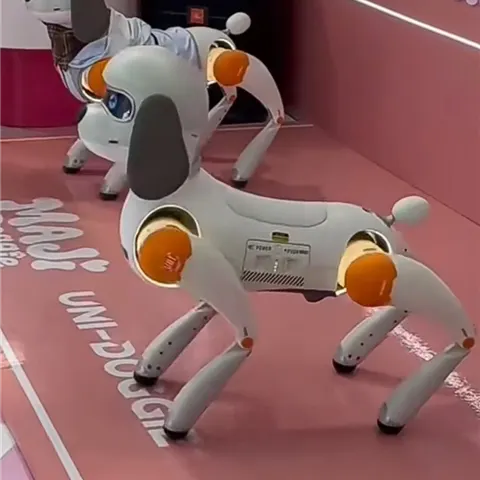
NEURA also offers a smaller version, the 4NE1 Mini, reservable for €100. The Standard version is €19,999 (education, voice interaction, entertainment, no manipulation) and the Pro version €29,999 (education, interaction, research and manipulation, with dexterous hands at 12 degrees of freedomThe number of independent parameters needed to describe the position of a robot completely.Read the glossary entry), excluding taxes and shipping. The Mini page announces availability in 2026 with no date, whereas the 4NE1 product page still speaks of spring 2026.
On the customer side, these are announcements. In July 2025, HD Hyundai Samho, HD Hyundai Robotics and NEURA said they would first test the 4NE1 and four-legged robots in Hyundai shipyards in South Korea, on dangerous welding and assembly work; according to heise, a first prototype was planned by the end of 2026 and commercial use could come as early as 2027. None of the pages read reports a test result. In November 2025, Schaeffler announced it would deploy a medium four-digit number of NEURA humanoid robots in its production by 2035, a wording heise calls cryptic; neither company gave the exact number. Schaeffler also supplies actuators (up to 250 Nm of torque) that the 4NE1 already uses and that NEURA intends to source from it in future.
In France
Nothing in the pages read concerns France. The reservation page names no delivery country, taxes and shipping are added to the price with no amount, and it only mentions terms and a right of withdrawal that apply at checkout. NEURA says the robot is developed, built and trained in Germany; it describes no warranty and no maintenance.
What would settle it
Four points to watch before paying a deposit, even a refundable one: NEURA publishing a price and a date for the Gen 4, or saying which of the two ships at the end of 2026; NEURA correcting or explaining the 80 kg weight; a third party showing the robot on a real task, with the share done without an operator; and Hyundai and Schaeffler publishing results. According to the page, the €100 deposit is refundable before the final purchase agreement is signed: reserving costs little, but guarantees neither the version nor the date.
Sources
- NEURA Robotics, 4NE1 Gen 3.5 reservation page (estimated price, deposit, interfaces, delivery), read on 16 November 2026 · neura-robotics.com
- NEURA Robotics, German reservation page (no price tier), read on 16 November 2026 · neura-robotics.com
- NEURA Robotics, 4NE1 product page (Gen 4, height and weight, home section, Mini), read on 16 November 2026 · neura-robotics.com
- NEURA Robotics, 22 October 2026 release (TUM RoboGym, 4NE1 Gen 4), read on 16 November 2026 · neura-robotics.com
- NEURA Robotics, 4NE1 Mini page (Standard and Pro prices, deposit), read on 16 November 2026 · neura-robotics.com
- heise online, 26 October 2026 article (about 64 kg, textile skin, Neura Gyms), read on 16 November 2026 · heise.de
- Humanoid.guide, 4NE1 Gen 3.5 sheet of 23 October 2026 (listed price, weight, battery life), read on 16 November 2026 · humanoid.guide
- Humanoid.guide, 4NE1 Gen 4 sheet of 27 October 2026 (listed price, weight, capabilities), read on 16 November 2026 · humanoid.guide
- heise online, 16 July 2025 article (Hyundai shipbuilding tests), read on 16 November 2026 · heise.de
- heise online, 6 November 2025 article (Schaeffler, number of robots, actuators), read on 16 November 2026 · heise.de
Also worth reading
 Illustration, not a photo of the robot
What next