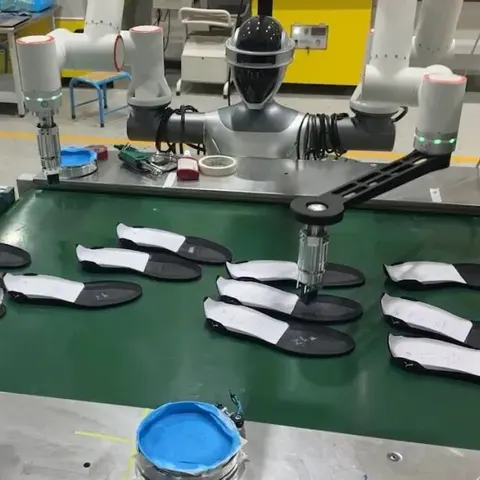
What a robot “brain” does, in practice
The four models in this guide are “vision-language-action” models, or VLAs: they take camera images, sometimes the robot’s state (the position of its joints) and a written instruction, and they output actions, meaning commands for the motors. NVIDIA describes GR00T this way: images, text and robot state in, continuous action vectors out. Hugging Face describes SmolVLA in the same terms.
This “brain” is only one layer of the robot. For the Unitree G1, the GR00T N1.7 repository describes a set-up in which the model does not drive the joints directly: it predicts compact action tokens that a whole-body controller, also learned, turns into commands for the legs, arms and hands.
NVIDIA’s GR00T N1.7: the model NVIDIA aims at humanoids
NVIDIA presents GR00T N1.7 as an open model for generalized humanoid robotA robot whose form follows that of the human body, with a torso, two arms, a head and most often two legs.Read the glossary entry skills, with 3 billion parameters. According to the repository, it was trained on a mix of data from two-armed robots, semi-humanoids and humanoids, plus 20,000 hours of video of people (the EgoScale set). To adapt it to a given robot, training continues with that robot’s data.
On hardware, NVIDIA says inference needs a graphics processor (GPU) with 16 GB of memory or more, for example an RTX 4090 or a Jetson AGX Thor or Orin board, and recommends 40 GB or more to adapt it to your robot. NVIDIA’s two pages do not give the same speeds. The repository reports about 40 Hz on an RTX PRO 6000 Blackwell Server Edition and about 28 Hz on a Jetson AGX Thor set to maximum, with TensorRT, on the LIBERO benchmark, handling one request at a time. The model card, for 4 denoising steps and one camera, gives 35.9 Hz on an RTX Pro 6000 Blackwell and 10.7 Hz on a Jetson AGX Thor, again with TensorRT; the two pages do not describe their measuring conditions in the same way. There is one more step before anything runs: the repository states that the vision-language part of GR00T, NVIDIA’s Cosmos-Reason2-2B model, is hosted on Hugging Face with access on request, and that without that access the loading fails.
Licence: the code is under Apache 2.0. For the weights, the model card and the repository’s licence section cite the NVIDIA Open Model License, whose terms Vuntum has not read. Yet the top of the same repository says the model is “fully commercially licensable under Apache 2.0”: clarify this with NVIDIA before any commercial use.
On testing, the model card cites simulated tasks (9 DexMG tasks, 24 from RoboCasa, 24 with a simulated GR-1 humanoid) and real-robot trials: grocery packing, objects never seen in training, and industrial coordination of several robots with hand-overs. The card defines these trials by pointing to a white paper, the one for GR00T N1, which Vuntum has not read: this guide therefore gives no success rate.
Physical Intelligence’s π0 and π0.5: open, but π0 was first built for the publisher’s own robots
The openpi repository, published by the Physical Intelligence team, holds three models: π0, π0-FAST and π0.5. Each comes as a base version trained on more than 10,000 hours of robot data, with examples for using it as is or fine-tuning it.
Memory the repository asks for, on an NVIDIA GPU: more than 8 GB for inference (an RTX 4090 as an example), more than 22.5 GB for light fine-tuning (LoRA), more than 70 GB for full fine-tuning (A100 80 GB or H100). The repository has been tested on Ubuntu 22.04 only. Its code is under the Apache 2.0 licence; the README we read does not state a licence for the weights.
The publisher warns of this itself: the repository is “an experiment”, π0 was developed for its own robots, which differ from the widely used platforms, and it does not expect every attempt at adapting it to succeed. Its words: “π0 may or may not work for you”.
Hugging Face’s SmolVLA: a small model, for an ordinary machine according to its publisher
SmolVLA has 450 million parameters, roughly seven times fewer than GR00T N1.7. Its card gives the Apache 2.0 licence and presents it as a base model to adapt to your use. Hugging Face says it was pretrained only on community-shared datasets under compatible licences, and says it is small enough to run on a CPU, train on a single consumer GPU, or even a MacBook (the publisher’s wording).
Hugging Face also claims it matches or exceeds much larger models in simulation (LIBERO, Meta-World) and on real tasks: that is the publisher’s claim, which Vuntum has not checked. The real-world trials cited use SO100 and SO101 arms, hardware Hugging Face calls very affordable, not humanoids.
OpenVLA: a licence to check
OpenVLA 7B has 7.54 billion parameters according to the metadata of its Hugging Face page, which displays “8B”. It was trained on 970,000 manipulation trajectories from the Open X-Embodiment dataset, and its first release dates from June 2024. Its code is under the MIT licence.
For the weights, the two pages do not say the same thing. The Hugging Face card says all OpenVLA checkpoints are released under the MIT licence. The GitHub repository warns instead that these models may inherit the restrictions of their base models and that, derived from Llama-2, they are subject to the Llama Community License. Unable to settle it, Vuntum gives no answer: commercial use means reading both pages.
The brains the pages we read do not offer for download: Figure’s Helix and DeepMind’s Gemini Robotics
Figure introduced Helix on 20 February 2025. According to that presentation, it controls the whole upper body of a humanoid (35 degrees of freedomThe number of independent parameters needed to describe the position of a robot completely.Read the glossary entry, at 200 Hz) and runs entirely on board, on two low-power embedded GPUs. Figure describes it as a combination of a 7-billion-parameter model that understands the scene and the instruction with an 80-million-parameter model that drives the movements. According to Figure, it was trained on about 500 hours of teleoperated behaviours. The page we read offers no download and no licence; it states that the first of the two models builds on an open vision-language modelAn AI model trained on large quantities of image-text pairs, which links what it sees to descriptions in natural language.Read the glossary entry with public weights.
Google DeepMind presents Gemini Robotics 2 as its most advanced vision-language-action (VLAA model that takes images and a natural-language instruction as input and directly produces a robot’s actions.Read the glossary entry) model, “capable of intelligently controlling any type of robot, from bi-arms to full humanoids”, paired with a reasoning model (ER 2) and a version “optimized to run locally on robotic devices” (On-Device 2). To test its models, DeepMind offers a waitlist for early access (ER 2 also shows a trial button); it says it works with more than 100 “trusted testers” and names three research partners: Agile Robots, Apptronik and Boston Dynamics.
What “open” does not mean
Our reading: a downloadable model is not a robot working in your home. The workflow NVIDIA documents for the G1 goes through collecting demonstrations by virtual-reality teleoperationControl of a robot at a distance by a human operator, live, using a dedicated interface.Read the glossary entry, then fine-tuning the model on that data, then deploying it. NVIDIA also writes that integrating such a model into a system calls for testing specific to each use before deployment, to ensure it is safe and effective.
Our reading, still: these models are building blocks for technical teams. A buyer activates none of them with a click, and the fact that a manufacturer uses an open model says nothing about what its robot does on its own.
Three questions to ask when a new model is announced
Are the weights downloadable, and under what licence? The first four are (GR00T after an access request), under different licences that are sometimes contradictory from one page to the next; for Helix and Gemini Robotics, the pages we read offer no download.
Where does the model run, on the robot or on a server? GR00T is measured on a Jetson board but its repository also describes running on a server, openpi offers remote inference, Helix runs on board according to Figure, and DeepMind describes a version designed to run locally. For a robot at home, the answer bears, in our view, on privacy and on working without a connection.
Measured where, and on which robot? A simulation, a laboratory arm and a humanoid in real conditions do not prove the same thing. These three questions are ours, not those of the publishers cited.
What Vuntum read, and what it did not do
All the pages cited were read on 8 November 2026: code repositories, model cards and the publishers’ presentation pages. Vuntum ran none of these models and repeated no measurement: sizes, memory and speeds are those of the publishers or their pages, with no independent measurement. Licences and versions change: before any use, read the current licence texts and, where they contradict each other, ask the publisher.
Sources
- NVIDIA, Isaac-GR00T repository (GR00T N1.7 README), read on 8 November 2026 · github.com
- NVIDIA, GR00T-N1.7-3B model card on Hugging Face, read on 8 November 2026 · huggingface.co
- Physical Intelligence, openpi repository (README), read on 8 November 2026 · github.com
- Physical Intelligence, openpi repository licence, read on 8 November 2026 · github.com
- Hugging Face, SmolVLA model card (lerobot/smolvla_base), read on 8 November 2026 · huggingface.co
- Hugging Face, SmolVLA announcement blog post, read on 8 November 2026 · huggingface.co
- OpenVLA repository (README, licensing section), read on 8 November 2026 · github.com
- openvla-7b model card on Hugging Face, read on 8 November 2026 · huggingface.co
- Figure, article of 20 February 2025 on Helix, read on 8 November 2026 · figure.ai
- Google DeepMind, Gemini Robotics overview page, read on 8 November 2026 · deepmind.google
Also worth reading
What next