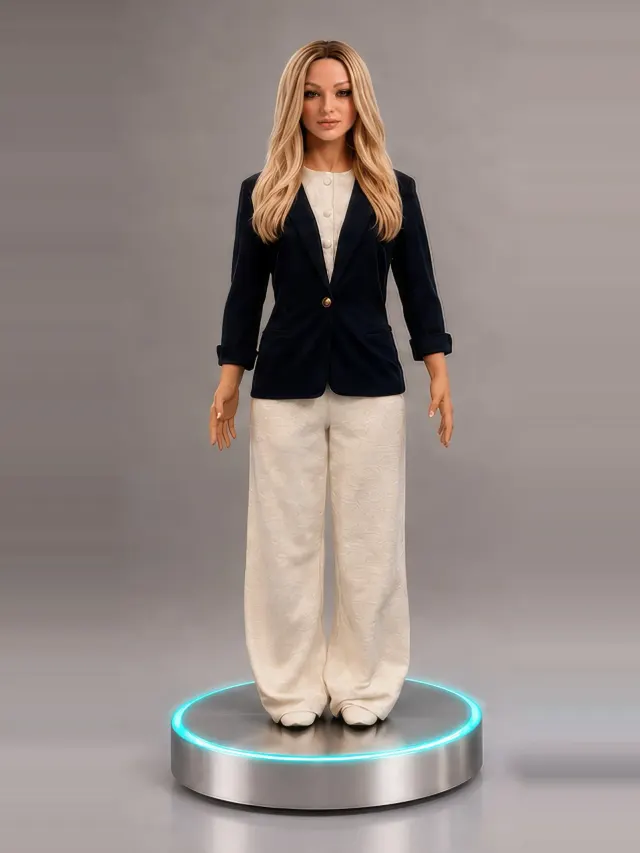
Realbotix Series 1 (formerly Echo): what a companion humanoid really costs, who listens in your home, and why you cannot order it in France
In late October 2026 Realbotix introduced a companion humanoid in two sizes, at $11,950 and $59,950, reservable for $199, with a mandatory subscription of at least $19.99 a month. First deliveries are expected from the second half of 2027, for 250 units and the United States only, with a warranty that also stops at its borders. The robot was renamed on 4 November: Echo became Series 1. Based on the maker’s pages read on 24 November 2026, a press article and a press release carried by the trade press.
A companion robot, renamed Series 1 in early November
In late October 2026 Realbotix introduced a line of companion humanoids under the name Echo (Humanoid.guide, 27 October). On 4 November the company renamed it Realbotix Series 1: according to the press release carried by Robotics Tomorrow, the change avoids a trademark concern and touches neither the robots, nor their specifications, nor the prices, nor the production plan. Vuntum’s sheets carry both names: Realbotix Series 1 and, under its old name, Echo.
There are two sizes, each with a choice of four characters (Aria, Mila, Dave and Amar), each with its own face, voice and personality. The Tabletop sits on a table: 17 degrees of freedomThe number of independent parameters needed to describe the position of a robot completely.Read the glossary entry, 31 or 32 inches tall depending on the female or male version (79 or 81 cm), 13 inches square (33 cm) and about 25 lb (11.3 kg). The Full-body has 39 degrees of freedom, stands 72 or 77 inches (1.83 or 1.96 m), is 28 inches square (71 cm) and weighs about 88 lb (39.9 kg). The maker says sizes and weights are approximate; the metric conversions are Vuntum’s. Both plug into a standard outlet. The skin is silicone on the face and neck, and on the Full-body also from the elbows down to the fingertips (Robotics Tomorrow).
What a Series 1 really costs
The Tabletop is $11,950 and the Full-body $59,950, without a subscription. Reserving costs $199 per robot, deducted from the price. Before building, Realbotix invoices 50% of the price, payable within 30 days of the invoice date: after that the reservation is cancelled and the $199 is not returned. The balance and shipping, whose amount is not published, are invoiced before dispatch. If Realbotix cannot deliver, it refunds the $199 and every payment made; otherwise the $199 is lost on cancellation. The pages do not say what happens to the 50% instalment already paid if the buyer backs out. Once the robot is delivered the sale is final and returns are not accepted, except for shipping damage reported within 7 days and warranty claims (terms of use). Prices are given in dollars only.
The robot does not work without a subscription: the pricing page calls an AI plan “required to run Series 1”, paid monthly in the Realbotix App once the robot has arrived; that app, needed to set up and run the robot, is still an invite-only beta that Realbotix may withdraw or end at any time (terms of use). There are four plans: Base at $19.99 a month for 10 hours of conversation; Plus at $39.99 for 40 hours, with more expressive voices, 100+ languages and accents and persona editing; Enterprise at $199 for 100 hours; Enterprise with Vision at $199 unlimited. When the hours run out the robot is “limited to basic functions”, which the pages do not define. The subscription can be cancelled at any time, at the end of the current period, and is not refundable, unused hours included.
The Vinci option, camera-based vision that recognises people, costs $24,950 on top, fits both sizes and requires the Enterprise with Vision plan. Vuntum’s arithmetic from these prices: 10 hours a month is 20 minutes of conversation a day over a 30-day month; a Tabletop on the Base plan costs $12,189.88 in the first year ($11,950 plus 12 times $19.99) and $13,149.40 over five years; a Full-body with Vinci is $84,900 of hardware and $2,388 of subscription a year. Shipping and taxes are not counted. The first 50 people to reserve get a $120 credit on the subscription, usable until 12 months after delivery; the offer ends once the 50 places are taken (terms of use).
What the robot does, and what the pages do not say
According to the maker, every Series 1 talks, listens and reacts with the personality set in the app. For the Full-body, the site details two cameras, four microphones, stereo speakers, fingers that move one by one and what the site calls “Emotional AI”, a claimed feature that Vuntum could not see in action. The pages do not detail the standard sensors of the Tabletop. Chief executive Andrew Kiguel says these robots are not remote-operated and that they decide and interact on their own, with on-device intelligence (Robotics Tomorrow); that is his statement, with no independent demonstration in the pages read. Realbotix announces live demonstrations at the Humanoid Summit in Silicon Valley (1 and 2 December 2026) and at CES in Las Vegas (6 to 9 January 2027).
On movement, read with care. Humanoid.guide points out that the Full-body’s 39 degrees of freedom serve fluid upper-body motion, not a fully articulated human body, and that the figure is no claim of unrestricted human mobility. None of the pages read describes walking or a carried load, and the pages describe a robot that plugs into an outlet without saying whether it has a battery: the word appears only in a general warranty exclusion. The uses the maker lists are education, companionship and daily check-ins for older people, wellness, hospitality and retail, and corporate services; the release adds therapy for the Tabletop, and the home page lists healthcare among the suggested uses of three of the characters. For the Tabletop (education, therapy, wellness), Humanoid.guide notes that these are intended uses, not deployment results.
Who hears and sees what in your home
The privacy policy, updated on 4 November 2026, says conversation history and saved memories stay on the robot and/or on the paired device, and that Realbotix does not receive, store or review them. But the conversations do not stay inside the machine: the policy says they are processed live by third-party AI providers. OpenAI writes the answers, under a zero-data-retention arrangement, and Microsoft Azure generates the voices. If you ask for another provider, such as Anthropic (Claude) or Google (Gemini), your conversations are processed under its own terms. Realbotix also receives usage logs, such as how long you talk, without their content. Other pages say otherwise: in the release, the chief executive credits these robots with “on-device intelligence”, the Enterprise with Vision plan, required with Vinci, announces speech and AI running on the robot itself, and the release speaks of complete local processing of conversations with Vinci. The privacy policy provides no exception, however, and the terms say the app and certain features of the robot require an internet connection.
With Vinci, the cameras recognise who is talking to the robot, read what the person is doing and sense how they feel. The maker says this data, learned faces included, stays on the robot and the phone, never in the cloud, and is kept until you delete it: faces in the app, all Vinci data on request by email. It also says its technicians may be able to see it during maintenance or repair. The pages do not say whether the cameras keep images or only face data, or what happens to the data if the robot or phone is lost or resold. The user must tell the people filmed and obtain their consent where the law requires it. The service is for adults; schools and care providers that make the robot available to minors are responsible for supervision.
Safety: what the maker says
Realbotix’s safety principles, also updated on 4 November, describe AI rules designed to stay in place even when the personality is customised, an AI designed to discourage unhealthy dependence and to say clearly that it is not a person. The robot is not a caregiver or a medical or emergency device: it may not recognise an emergency or respond to it properly. On the hardware side, the head and face, and on the Full-body the arms and hands, are motorised: keep hands, hair and clothing clear, place it on a stable surface, and stop it by unplugging its cable, which must stay within reach. Do not open, modify or repair it yourself. The pages read give no force or speed limit, no emergency stopA safety function that stops a machine when a person operates a dedicated control, in case of danger.Read the glossary entry other than the cable, and no certification.
Availability: the United States, and nothing else
The first deliveries are expected from the second half of 2027, as a non-guaranteed estimate, for 225 Tabletop and 25 Full-body units only. Reservations are open only for delivery within the 50 US states and the District of Columbia. The terms go further: the robot is intended for use in those areas only, it may not meet the electrical, radio or safety requirements of other countries, and outside those areas Realbotix provides no warranty, repair, support or parts; the app and the AI services may also not work there. The maker’s limited warranty lasts 12 months and covers the hardware only, not the software or the AI. The governing law is Nevada’s, with individual arbitration (JAMS, Clark County) and a class action waiver; the arbitration can be declined in writing within 30 days of accepting the terms. No page read announces sales in France or Europe. On the product side, Europe appears only in the privacy policy (cookies, rights of residents of the European Economic Area and the United Kingdom, data transfers to the United States) and in the safety principles (the EU AI Act).
Where the sources differ
Tabletop height: the site gives 31 inches for the female version and 32 for the male, where Humanoid.guide and the release give a single 32. The name: Echo at Humanoid.guide and in the October press, Series 1 since 4 November. The country: Humanoid.guide, quoting Interesting Engineering, calls it a Canadian company; Realbotix’s site says “Built in Las Vegas, Made in the USA” and the release carried by Robotics Tomorrow describes a US developer whose robots are made in the United States, listed in Toronto, Frankfurt and over the counter. Languages: the release says all models handle more than 100 languages, while the pricing page puts “100+ languages/accents” in the Plus plan and says nothing about the Base plan’s languages. The subscription: Humanoid.guide mentions one without giving its price, which the pricing page sets from $19.99. Vuntum ordered and tested nothing: everything above is what the maker and the press write.
Sources
- Realbotix, Series 1 page (prices, versions, 225 and 25 units, delivery), read on 24 November 2026 · realbotix.com
- Realbotix, pricing (deposit, payments, AI plans, Vinci option), read on 24 November 2026 · realbotix.com
- Realbotix, terms of 4 November 2026 (reservation, refunds, delivery area, warranty, governing law) · realbotix.com
- Realbotix, privacy policy of 4 November 2026 (conversations, AI providers, Vinci data) · realbotix.com
- Realbotix, safety principles of 4 November 2026 · realbotix.com
- Realbotix, FAQ (delivery area, uses), read on 24 November 2026 · realbotix.com
- Robotics Tomorrow, 4 November 2026 (Echo becomes Series 1, specifications, languages, chief executive’s statement) · roboticstomorrow.com
- Humanoid.guide, 27 October 2026 (Echo launch, reservations on mobility and intended uses) · humanoid.guide
Also worth reading

What next

 Illustration, not a photo of the robot