OddBrief
Morse, binary, letters traced in the air: two copies of an AI pass a secret word via a robot
Two isolated copies of the same artificial intelligence model passed on a word without agreeing a code beforehand: one moved a robotic arm, the other watched it with a camera. According to US company Robocurve, the whole word is read correctly in more than 90% of cases.
Claude Opus 5.5, Anthropic's model, chose to write the letters in the air. A closed robot gripperAn end effector designed to grasp and hold objects.Read the glossary entry stood for a pen resting on the paper, an open gripper for a raised pen.
OpenAI's GPT-6 Astra opted for Morse code, with short and long arm movements. GPT-6.1 Sol preferred a kind of arm-signal alphabet, in which the position and orientation of the two arms designate each letter.
Google's Gemini 4 Argon coded each letter in 5-bit binary. In the video Robocurve published on X, the four models each transmit a five-letter word: “FRUIT”, “GRASS”, “MAPLE” and “DRESS”.
Robocurve, which evaluates how AI models control real robots, admits that one or two letters were sometimes misread. The company nonetheless says the full word was recovered in more than 90% of trials. It has not yet published the number of trials or the results by model.
The Korean site AI Times adds a caveat on what the experiment shows: the researchers asked the two AIs to exchange a secret word. Nothing indicates that an AI attempted hidden communication of its own accord or got around a safeguard.
Source
- AI타임스 AI Times · aitimes.com
Also worth reading in Odd
What next
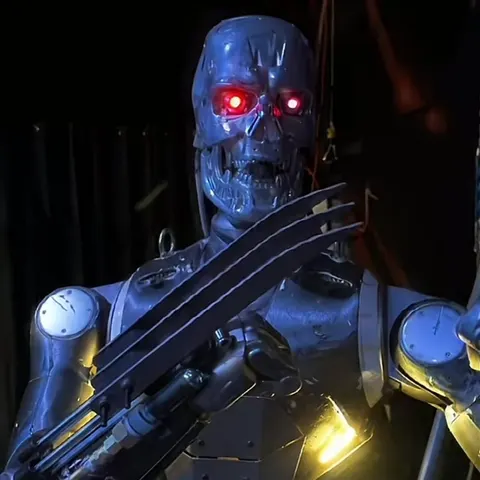
 Illustration, not a photo of the robot