ResearchBrief
A fine artificial muscle lets a robotic hand press piano keys and mechanical eyes move
Engineers have built an artificial muscle fine enough to control the force of a robotic finger on a piano and to hold the gaze of mechanical eyes. Humanoid robots still struggle with such delicate movements.
According to Popular Science, a team from the University of Pennsylvanie describes a highly controllable artificial muscle in a study published this week in Advanced Functional Materials. It is inspired by the small muscles of the human eyes and fingers.
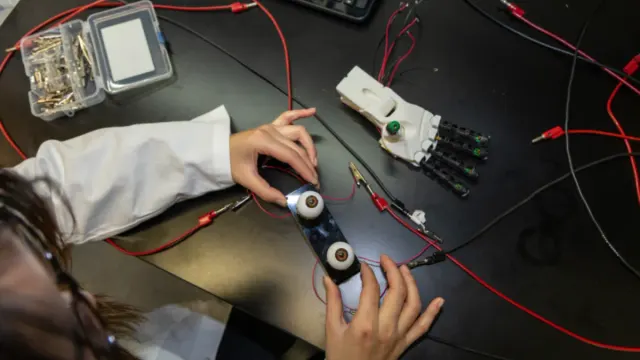
First test: the muscles were fitted in a 3D-printed robotic hand, which pressed several piano keys with different forces and speeds.
Second test: robotic eyes fitted with these fibres shifted their gaze on demand, with controlled, repeatable movements.
The muscle fibre combines a liquid crystal elastomer, a rubber-like material, with graphene and an embedded ultrafine copper coil.
The researchers say the next step is to combine more of these muscles in larger systems, to produce more natural expressions.
Source
- Popular Science · popsci.com
Also worth reading
What next