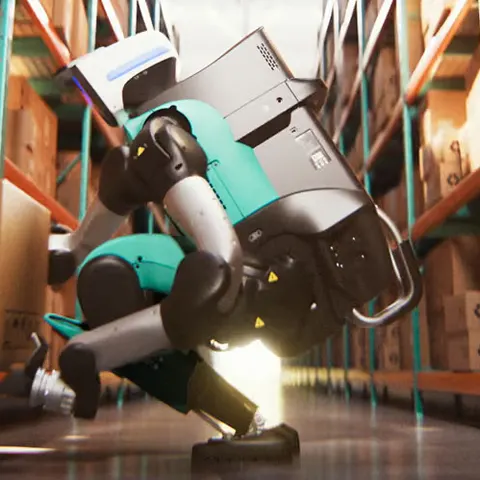
A warehouse robot meant to work without barriers
Agility Robotics, whose headquarters and RoboFab factory are in Salem, Oregon, unveiled the fifth generation of its Digit humanoid on 15 September 2026. Digit is built for handling work in warehouses and factories: moving bins and lifting them onto shelves. The Digit 5 product page says it is in development and that its features, capabilities and designs may change ("subject to change"). Almost everything below is therefore an announcement, and we keep it apart from what has already been observed.
The announced figures, and where they differ
On payloadThe maximum mass a robot arm can carry at its wrist.Read the glossary entry, the pages read agree: 23 kg (50 lb); Jonathan Hurst, an Agility co-founder, adds that the robot must be able to lift it repeatedly, as the US occupational safety institute (NIOSH) recommends for human workers. On working time too: the product page announces 20 hours out of 24, Hurst speaks of 20 hours a day in IEEE Spectrum (19 October 2026), and Evan Ackerman of more than 20 hours a day (IEEE Spectrum, 15 September). Only Hurst gives the battery and recharge times: it is meant to allow 90 minutes of operation and a full recharge during a 9-minute break, which matches the 10 to 1 ratio on the product page. The product page states that its figures are preliminary estimates based on internal testing and benchmarking of pre-production hardware and software configurations. Hurst's durations are design targets. None of these values is a measurement in operation or an independent measurement.
Reach varies from page to page. The product page gives 2.2 m; Evan Ackerman writes that Digit 5 lifts 23 kg up to 2.1 m. Jonathan Hurst cites shelves 1.75 m high, as a requirement drawn from those same recommendations, not as a maximum reach. For the 2.2 m and the 2.1 m, none of the pages read says what is measured. On size, the sources do not contradict each other: 129 kg and 1.8 m tall according to Evan Ackerman, over 120 kg according to Jonathan Hurst, who gives no height; the product page gives no mass. Hurst explains that the battery and cooling take up about 75% of the torso, and that all this extra bulk (motors, battery, safety equipment) stops Digit 5 from running or jumping as earlier generations did. Humanlike legs replace the backward legs, which caused problems with squatting. He describes the robot himself as the largest, heaviest and most expensive Agility will ever build, without giving a price.
Safety, the central promise
According to Jonathan Hurst, in Digit 4's commercial deployments the robots had to work behind physical barriers, separated from humans at all times, to meet insurance and regulatory demands. Digit 5 is designed to do without them. It is meant to rely on sensors to locate nearby people; according to Hurst, when one approaches, it is programmed to stop, set down its payload, sit on the floor and cut power to its motors before the person can touch it. Evan Ackerman describes the same logic, adding that the robot sits down if necessary, without mentioning the motors being cut. Hurst counts two years of work on this.
What is said, and what is not. Agility's product page writes that its human detection software and functional safety behaviours are designed to render external barriers unnecessary in live deployment settings, but also that certain safety features are still in development and that safety features do not eliminate all operational risk. Hurst also lists, among the requirements of customer deployments that Digit 5 must meet, European CE compliance, North American UL electrical-safety certifications and FCC limits on electromagnetic radiation. Evan Ackerman judges that the approach works ("it works") without saying what he bases this on, and a caption in his article notes that on 15 September Agility did not yet have Digit 5 deployed in factories ("Agility doesn’t have Digit 5 deployed in factories yet"). The pages read mention no certification already obtained for Digit 5. A favourable judgement is not a deployment.
What earlier versions have done for customers
At GXO, a pilot began in late 2023 at Flowery Branch, Georgia, and a multi-year robots-as-a-service (RaaS) agreement was signed in June 2024. According to Agility and GXO, Digit has moved more than 100,000 totes there, placing them onto conveyors alongside existing automation. Agility also cites more than 65,000 hours of real-world operation across all its commercial operations and customer programmes, without distinguishing versions; the Digit 5 product page relies on those hours as training data. These are figures from the company and its customer: none of the pages read cites independent verification.
Agility's 26 October release on its commercial momentum names other customers: Toyota Motor Manufacturing Canada, which signed a commercial agreement after a successful pilot; Schaeffler, both an investor and a user in automotive manufacturing; Mercado Libre; and AGCO, whose pilot at its Hesston, Kansas plant is due to start in 2027. Three further customers, manufacturers in paid programmes, chose not to be named. Jonathan Hurst also writes that Amazon tested Digit 4. In its forward-looking statements, that release mentions deployment commitments at nine customer sites, in addition to the two new GXO sites.
The same day, Agility and GXO announced two more sites, in Statesville, North Carolina and Lebanon, Tennessee, for e-commerce logistics, on highly repetitive material-handling tasks. Deployments are due to start in early 2027 with Digit 4, then move to Digit 5 once it is commercially available: these sites are therefore due to start with Digit 4. GXO's chief executive, Patrick Kelleher, says in that release that the expansion reflects GXO's confidence in the technology's ability to create measurable value for its customers and a better working environment for its teams. The Robot Report and AI Weekly also report that he told investors in August that GXO had not yet achieved a return on investment with humanoids and that it would take a couple of years. Jonathan Hurst writes, without saying which ones, that keeping Agility's first deployments running took so much time and effort that it arguably eliminated any profit Agility made from them.
Price, timing, orders
No Agility page read shows a selling price for Digit 5. The only orders of magnitude come from a document filed with the US securities regulator in June. According to that document, as Evan Ackerman reports it, the cost of the parts alone is probably US$150,000 to $200,000 at launch; Agility anticipates, on the basis of real production data, that this cost should fall below $50,000 per robot with some near-term optimising and a production volume of 10,000 robots a year. That is not a selling price, nor even the full cost of building one. The same filing gives, as a purely illustrative figure ("purely illustrative"), a service offer of about $8,500 a month. On the assumptions Ackerman cites (20 hours of work a day, an employee costing the employer $30.50 an hour), Agility estimates that Digit 5, as a service, could save the employer about $100,000 a year per robot. Ackerman stresses that all these figures are only estimates, and that the comparison assumes Digit 5 will be an effortless drop-in replacement for human labour, which he is not entirely sure has ever happened with any robot, anywhere.
According to Agility's 26 October release on its commercial momentum, early access for the first customers is due to begin in the first half of 2027, with general availability targeted for the end of 2027, no region specified. Evan Ackerman writes that buyers in the European Union and the United Kingdom should be able to buy the robot in 2027; no Agility page read gives a country-by-country schedule. On orders, Agility has already reported more than $300 million of multi-year orders for Digit 5, specifying that this is potential value, subject to contractual milestones and to product features and specifications, and does not represent current revenue. The 15 September release, quoted by Ackerman, dates that figure to May 2026; Ackerman infers a number of robots comfortably under 1,000. The RoboFab factory in Salem is designed to produce up to 10,000 robots a year according to the releases (more than 10,000 according to a caption in Jonathan Hurst's article).
These announcements come from a company preparing to go public by merging with a listed acquisition company, Churchill Capital Corp XI; closing is expected in the fourth quarter of 2026. The 26 October release on commercial momentum itself lists among its risks an emerging technology facing significant technical challenges and that may not achieve commercialisation or market acceptance, historical net losses and a limited operating history.
How to read what comes next
When a new Agility figure appears, three questions help place it. Does it concern Digit 4, already in service, or Digit 5, still in development? Was it measured by a customer or a third party, or announced by the manufacturer? The announced battery life is 90 minutes for 9 minutes of charging (Hurst), the 10 to 1 ratio of the product page: 20 hours of work a day assume frequent recharging, not a single charge. For France, nothing read gives a country-by-country schedule or a price: Agility is aiming at general availability at the end of 2027 without specifying a region, and Evan Ackerman writes that buyers in the European Union should be able to buy the robot in 2027.
Sources
- agilityrobotics.com, Digit 5 page, accessed on 29 October 2026 · agilityrobotics.com
- agilityrobotics.com, home page, accessed on 29 October 2026 · agilityrobotics.com
- Agility Robotics, press release of 26 October 2026 on customers and orders, read on 29 October 2026 · agilityrobotics.com
- Agility Robotics and GXO, press release of 26 October 2026 on the expanded partnership, read on 29 October 2026 · agilityrobotics.com
- IEEE Spectrum, article by Jonathan Hurst of 19 October 2026, read on 29 October 2026 · spectrum.ieee.org
- IEEE Spectrum, article by Evan Ackerman of 15 September 2026, read on 29 October 2026 · spectrum.ieee.org
- The Robot Report, article of 26 October 2026 on GXO and Agility, read on 29 October 2026 · therobotreport.com
- AI Weekly, alert on the extension of the Digit deployment at GXO, read on 29 October 2026 · aiweekly.co
Also worth reading in Humanoids
 Illustration, not a photo of the robot


What next