


Football robotsBrief
NAO robot learns to score in 30 minutes, 100% success rate according to researchers
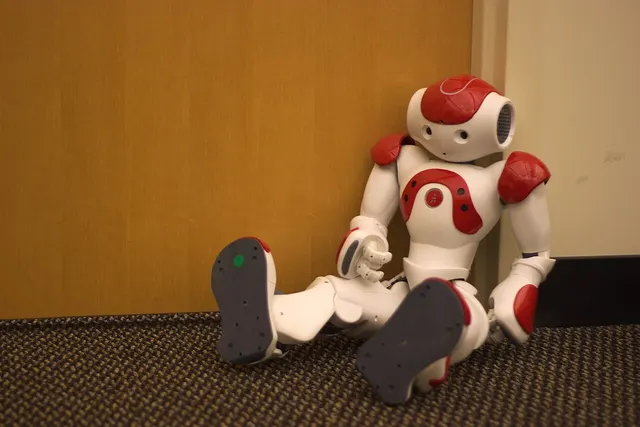
In a paper published on arXiv, a team of researchers describes how a biped robot learns, by trial and error, to push a ball into the goal.
According to the authors' abstract, the robot learns to score from several starting positions after 30 minutes of real-world interaction. It reaches a 100% success rate, against 0% for a so-called “feed-forward” policy trained with the same budget. The abstract does not say how many trials these rates are based on.
The robot relies on its own sensors. The researchers estimate all the relevant variables on board with a Kalman filter, with no motion capture system and no cameras mounted above the pitch.
This filter can go wrong when the ball is not observed. The authors therefore add a learned model that corrects its internal representation only when the ball is observed.
The researchers supplemented the robot trials with a simulation study. According to them, their method, called RSSM-RLPD, achieves a higher success rate there than imitation learning and two other baseline methods.
The paper has been submitted to the ICRA 2027 robotics conference.
Source
- arXiv (cs.RO, robotics) · arxiv.org