RoboParty RP1: the open-source humanoid for researchers, what you can download, what you can order and the figures that differ
RoboParty, a young Shanghai company, presents the RP1 as a “full-stack open-source” humanoid for researchers, teachers and developers. The machine’s plans (CAD, electronic boards, bills of materials) are indeed published on GitHub under open licences; part of the software is announced for later. The maker publishes no price: it offers a purchase enquiry form, and only a third-party catalogue shows $16,000. Height, weight and joint count vary from one source to another, and the team’s scientific papers report their trials on a different robot. Pages read on 24 November 2026.
A humanoid for the lab, not for the living room
RoboParty is a Shanghai company founded in 2025 (press release of 15 October 2026). It showed the RP1, also called ROBOTO 01, on 28 September 2026 at the IROS conference (Robotstart), held in Pittsburgh in the United States (Robot Newspaper). The maker’s product page puts it squarely on the research side: the robot is aimed at researchers and independent developers, and the press adds teachers and embodied-AI teams (Robotstart, Robot Newspaper). None of the pages read mentions home use: no household task, no consumer offer. It is a lab and workshop tool, to be read as such. Vuntum sheet: RoboParty RP1.
The RP1 follows the RPO (ROBOTO ORIGIN), a project released fully open source in January 2026, which had more than 2,500 GitHub stars according to Robotstart and Humanoid.guide, and more than 2,600 according to the press release. The founder, Yi Huang, says humanoids should not be closed systems that only a handful of teams can build (Robotstart).
Two versions, one base
According to the maker’s product page, read on 24 November 2026, the RP1 comes in two versions. The “Open Source” version has 24 actuated joints and weighs about 39 kg with its hand and battery; its arms have 5 joints each, and it carries a motion-control head, a prosthetic-style dummy hand and no camera as standard. The “Open Source PRO” version has 30 joints and weighs about 41 kg; its arms have 7 joints each, its head has 2, and it gets a hand with 6 degrees of freedomThe number of independent parameters needed to describe the position of a robot completely.Read the glossary entry, a single colour camera, a microphone, an interaction screen, voice control and a second processor (A733) next to the RK3588 that both versions share. An NVIDIA Orin NX 16 GB module is offered as an option for development.
The count adds up: two arms of 5, two legs of 6 and 2 joints at the waist make 24; two arms of 7, two legs of 6, 2 at the waist and 2 at the neck make 30. These totals do not count the dexterous hands (press releases).
The two versions share, according to the product page: a height of 1.35 m, a running speed of at most 4 m/s (14.4 km/h), a 3 kg payloadThe maximum mass a robot arm can carry at its wrist.Read the glossary entry, a peak torque of 160 N·m for the joint module with a 100 mm outer diameter, a 30° slope and a maximum step height of 50 mm. The 6 Ah battery gives 3 h of runtime, charges in 1.5 h and can be swapped without switching the robot off. On safety, the page cites a three-channel redundant emergency stopA safety function that stops a machine when a person operates a dedicated control, in case of danger.Read the glossary entry, fully enclosed joints against pinching and an operating range of −10 to 40 °C; it cites no certification. It adds that speed, runtime and performance vary with load, terrain, battery state and software configuration.
The figures that do not match
Height: 1.35 m on the product page, about 1.3 m in the press releases, 130 cm for the Humanoid.guide catalogue. Weight: about 39 kg and 41 kg on the product page, 34 kg for Humanoid.guide, which does not say where the figure comes from and describes a robot with 30 degrees of freedom. Joint count: 24 and 30 on the product page and in the press releases, but the main GitHub repository mentions configurations with 24, 28, 30 and 42 degrees of freedom, which neither the product page nor the press releases detail. Finally, the product page mentions an education edition and an advanced custom edition, with no specifications, to be requested by email.
Vuntum measured nothing and settles none of these gaps: the maker’s figures are those of its site, with that caveat.
Open source: what you can download today
RoboParty splits the project across several GitHub repositories. The main repository (1,231 stars and 185 forks on 24 November 2026) is a table of contents: it holds only images, the licence (GPL-3.0) and the presentation files, and points to one repository per part, each with its own licence. Gagadget wrote on 16 October, citing Runtime Wire, that the repository held presentation material rather than the engineering stack: that most likely describes this table of contents, not the hardware repository.
That hardware repository (rp1_hardware, created on 30 September 2026, 92 stars and 38 forks) is the most concrete. It holds the SolidWorks source files of the complete robot, a Parasolid model and the editable drawings, supplied as archives with version 0.1.0; the manufacturing files for the electronic boards (Gerber, placement data, bills of materials); the wiring harness drawings; and the parts lists, with references and quantities, for two configurations of revision RP1.3.4, named “5DOF + MotionHead” and “7DOF + MotionHead” (probably the arms with 5 and 7 joints of the product page). RoboParty’s own hardware designs are under the CERN-OHL-W-2.0 licence, the documentation under CC BY-SA 4.0, and third-party files keep their own terms. The README of that repository lists no assembly guide for the robot, only manufacturing and assembly requirements for the harnesses, while the main repository mentions assembly procedures.
On the software side there is the deployment kit (roboparty_deploy, shared with the RPO, 96 stars, GPL-3.0) for the motors, the inertial unit, inference and the depth cameraA camera that measures, for each point of the image, the distance separating it from the scene, and so produces a depth map in addition to, or instead of, the colour image.Read the glossary entry, in C++ with a documented Python interface, whose RP1-specific documentation is marked “coming soon” (only the RPO’s is written); the firmware (RP1_firmware, GPL-3.0); a training workspace for Isaac Lab (roboparty_train), described for the RPO and the RP1, whose licence does not appear in GitHub’s data (a README badge says BSD-3); and the robot models for simulation (RP1_description, URDFAn XML file format used in ROS to describe a robot’s geometry and organisation: its segments, its joints and their limits, its visual and collision shapes.Read the glossary entry and MJCF formats). The models repository shows no licence, neither on its page nor in GitHub’s data: what one may do with it remains to be clarified with RoboParty.
Not everything is there. Three learning projects carry the note “RP1 support coming soon”: IBFM, PredActor and INTACT-JEPA. The French-language press release says the PartyOS system is in continuous development, that perception, interaction and higher-level task execution are still being integrated and validated, and that other components will be opened progressively. Robotstart and Robot Newspaper report an open-source roadmap to be announced in October 2026, then a wider release of software and hardware and a mass-production plan at the end of the fourth quarter; apart from an undated “PartyOS Technology Roadmap” graphic in the press release, Vuntum found no page detailing that roadmap.
Buying an RP1: what the maker says, and what it does not
The 15 October press release announces the official launch of the RP1, with no price, no delivery date and no availability by country. The product page shows no price and offers no online order: its “purchase / partnership” button opens an enquiry form. The form asks for a name, a region (Europe is one of the choices), a contact method, the version wanted (Open Source or PRO), the intended use (research, teaching, product development or personal exploration, among others), the acceptable delivery time and the quantity. It shows no price, no deposit and no delivery date: filling it in only expresses interest and agrees to be contacted by the team. Gagadget concluded on 16 October that the robot was not yet on sale, with no distributor or pre-order named in the United States and the United Kingdom.
The only price seen is the Humanoid.guide catalogue’s: $16,000, next to an “inquire about price” button, with the availability “prototype” and the label “not verified”. The page does not say where the figure comes from, and RoboParty does not publish it. From the pages read, there is no distributor, no price in euros and no announced sale in France: a French lab, school or individual has, for now, only that form.
What the robot has shown, and what the team’s papers say
At IROS, the “Kick Me” demonstration invited visitors to push or kick the robot, which recovered its balance (Robotstart, Robot Newspaper); Robotstart adds that it got back up after a fall. The press release also cites continuous walking, human motion tracking and virtual-reality teleoperationControl of a robot at a distance by a human operator, live, using a dedicated interface.Read the glossary entry, with the in-house software PartyOS, UFO (unsupervised reinforcement learning) and MimicLite (motion imitation) (press release of 15 October, picked up by engineering.com). These are capabilities announced by the maker: Vuntum has not seen this robot and found no independent test.
The main repository points to scientific papers by the team. The abstracts of three of them, read at the source on arXiv on 24 November 2026, name another robot for the real-world trials: P-BFM (11 October 2026) reports zero-shot transfer to a Unitree G1, I-BFM (5 October 2026) real-world experiments on a Unitree G1, PredActor (21 September 2026, revised up to 5 October) a deployment on a Unitree G1. None of the three abstracts mentions the RP1. Vuntum read only the abstracts, not the full papers, which may describe other trials: the only conclusion is that this research does not, on its own, prove what the RP1 can do. Sheet of the robot used: Unitree G1.
What remains to be proven
Five points remain open. The real weight and height, between 34 and 41 kg and between 1.3 and 1.35 m depending on the source. The completeness of the repositories: “published” here means “present in the repository”, not “complete” or “reproducible”, and the simulation models show no licence. The price and availability, which only the maker can give. The roadmap announced for the end of 2026, with its mass production. Finally, trials of the RP1 itself, whereas the papers read report trials on a Unitree G1.
Vuntum has neither ordered, seen, measured nor built this robot, and downloaded no file from the repositories: the characteristics above are those published by the maker or reported by the press, with their sources at the end of the page.
Sources
- RoboParty, RP1 product page (versions, dimensions, joints, battery, compute, safety, open source), read on 24 November 2026 · roboparty.com
- RoboParty, RP1 “purchase / partnership” form (fields, no price or date), read on 24 November 2026 · roboparty.com
- PR Newswire, RoboParty press release of 15 October 2026 (launch, 24 and 30 joints, open-source contents) · prnewswire.com
- PR Newswire, RoboParty press release in French of 16 October 2026 (PartyOS, components to be opened progressively) · prnewswire.com
- GitHub, main RP1 repository (table of contents, GPL-3.0, 24, 28, 30 and 42 configurations, “coming soon” projects), read on 24 November 2026 · github.com
- GitHub, RP1 hardware repository (CAD, boards, bills of materials, CERN-OHL-W-2.0, version 0.1.0), read on 24 November 2026 · github.com
- GitHub, deployment kit roboparty_deploy (GPL-3.0), read on 24 November 2026 · github.com
- GitHub, firmware RP1_firmware (GPL-3.0), read on 24 November 2026 · github.com
- GitHub, training workspace roboparty_train (RPO and RP1, licence not declared, BSD-3 badge), read on 24 November 2026 · github.com
- GitHub, simulation models RP1_description (no licence shown), read on 24 November 2026 · github.com
- Robotstart, 5 October 2026 (IROS presentation, “Kick Me” demonstration, roadmap) · robotstart.info
- Robot Newspaper (Korea), 5 October 2026 (IROS in Pittsburgh, target users, timetable) · irobotnews.com
- Gagadget, 16 October 2026 (not yet on sale, presentation repository, what is missing) · gagadget.com
- engineering.com, 16 October 2026 (announced capabilities, in-house software) · engineering.com
- Humanoid.guide, 8 November 2026 (130 cm, 34 kg, 30 degrees of freedom, $16, 000, prototype) · humanoid.guide
- Humanoid.guide, RP1 sheet ($16,000, “inquire about price”, prototype, not verified), read on 24 November 2026 · humanoid.guide
- arXiv, P-BFM, abstract (transfer to a Unitree G1), read on 24 November 2026 · arxiv.org
- arXiv, I-BFM, abstract (real-world experiments on a Unitree G1), read on 24 November 2026 · arxiv.org
- arXiv, PredActor, abstract (deployment on a Unitree G1), read on 24 November 2026 · arxiv.org
Also worth reading in Humanoids
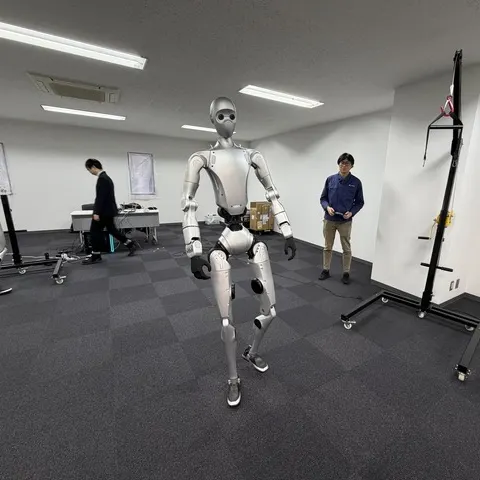
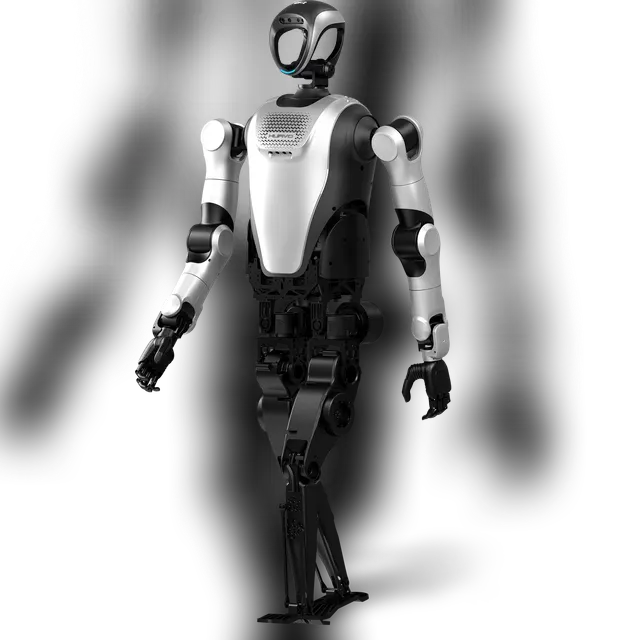
 Illustration, not a photo of the robot
What next