


HomeGuides
Buried wire or satellite: how a robot mower knows the limits of the garden
A buried wire or satellite positioning: robot mowers do not all learn the limits of a garden in the same way. This guide sets out what manufacturers say about each approach, and what the sources consulted do not document.
Two ways of drawing the boundary
It draws on pages from six manufacturers and two press articles, all consulted on 9 October 2026. The accuracy figures quoted are the manufacturers' own; we have not measured them.
The wire: what the installation guide covers
Husqvarna’s installation guide for the physical wire covers several steps: choosing the location, mounting and connecting the charging station, laying and connecting the boundary wire and the guide wire, pairing with the app, and then slopes, islands (objects to be isolated) and passages between zones.
Husqvarna points to a separate guide for wire-free EPOS installation, and writes that having no physical wire means "no wire breaks and more flexible area management". That is the manufacturer’s argument.
RTK: boundaries drawn in the app
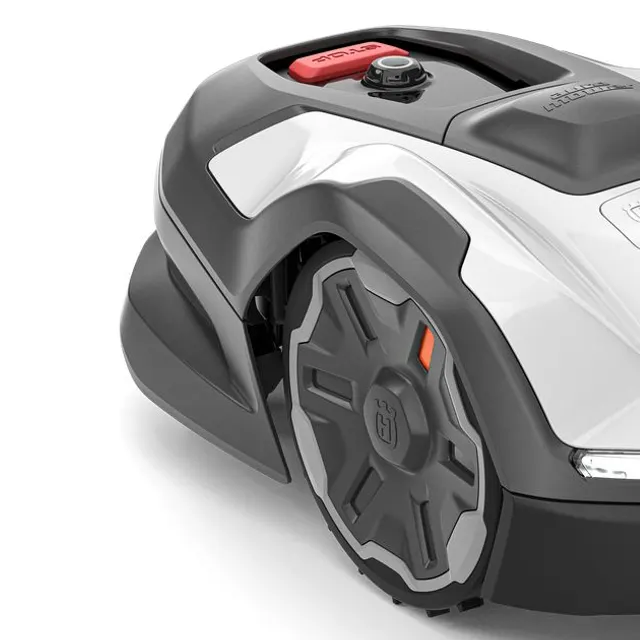
EPOS, Husqvarna’s system, replaces the buried wire with satellite positioning: the mower works within virtual boundaries, according to Husqvarna. It relies on RTK (Real-Time Kinematic), a satellite navigation technique that Husqvarna says is accurate to the centimetre within seconds. The boundaries are drawn from a smartphone using the Automower Connect app, and you can create several work zones with different settings.
Husqvarna lists the 410 iQ, 420 iQ, 440 iQ, 435 iQ AWD, 535 EPOS AWD, 560 EPOS, 580 EPOS and 580L EPOS as compatible with wire-free EPOS. The Husqvarna Automower 410VE NERA has a page on Vuntum, but none of the sources consulted says how it defines the mowing area.
What this means for your garden: sky, connection, shade
RTK needs corrections, and Husqvarna describes two ways of getting them: over the internet, via Husqvarna Cloud, with a constant mobile or Wi-Fi connection, or from a reference station. According to Husqvarna, that station needs a clear view of 135 degrees in every direction upwards, as well as a power socket. The charging station must also have a clear view of the sky.
For heavily shaded areas, Husqvarna’s FAQ says you can keep a little wire, though this is not compulsory. According to Mammotion, its iNavi service delivers NetRTK over 4G with no physical base station or antenna, free of charge for the product’s whole life cycle.
Models that add LiDAR or use it instead
Mammotion presents the LUBA 3 as wire-free and as needing no RTK installation. Its "Tri-Fusion" positioning combines a 360° LiDAR, NetRTK and a two-camera vision AI, with a stated accuracy of ±0.4 inch (about 1 cm). The manufacturer also states that LiDAR alone is enough, with no RTK or NetRTK, for up to 0.37 acre (about 1500 m²) on the LUBA 3 AWD 1500, whose page is Mammotion LUBA 3 AWD.
Ecovacs’s product page lists a rotating 360° LiDAR, a 3D-ToF LiDAR and an AI camera for the Ecovacs GOAT A1600 LiDAR Pro; Les Numériques writes that Ecovacs drops the RTK antenna in favour of LiDAR navigation. Its list price on the Ecovacs France site is €799.
According to the manufacturer’s page, the Dreame A3 AWD Pro combines a 360° 3D LiDAR with binocular AI vision for obstacle avoidance. Also according to Dreame, once the map has been made, mowing follows a schedule, even without a network connection.
Models combining RTK with cameras or LiDAR
Lymow says the Lymow One Plus uses RTK combined with VSLAM (camera-based mapping) for path planning and complete coverage. This model runs on tracks.
For the Segway Navimow i205 AWD, Futura Sciences writes that the combination of the EFLS system, the triple-frequency NRTK network and vision lets it map the garden automatically; the manufacturer presents it as a perimeter-wire-free robot mower. List price in France: €899.
According to Mammotion, the Mammotion LUBA 4 AWD combines three technologies: 360° LiDAR, NetRTK and four wide-angle cameras.
What we do not know, and what to check
None of the sources consulted compares the real-world reliability of wire and RTK over time. How long a wire takes to lay, what it costs and how often wires break are not documented here, and we do not estimate them.
Coverage of the correction network depends on the country and the manufacturer: check with the manufacturer before buying, along with the terms of the correction service, including the free access Mammotion announces.
Sources
- Husqvarna, page EPOS · husqvarna.com
- Husqvarna, installation avec fil physique · husqvarna.com
- Mammotion, page LUBA 3 · us.mammotion.com
- Ecovacs, page GOAT A1600 LiDAR Pro · ecovacs.com
- Les Numériques, bon plan GOAT A1600 LiDAR Pro · lesnumeriques.com
- Lymow, page One Plus · lymow.com
- Segway Navimow, page i205 AWD · navimow.segway.com
- Futura Sciences, Navimow i205 AWD · futura-sciences.com
- Mammotion, page LUBA 4 AWD · mammotion.com
- Dreame, page A3 AWD Pro · dreametech.com